Energy Data For Ireland

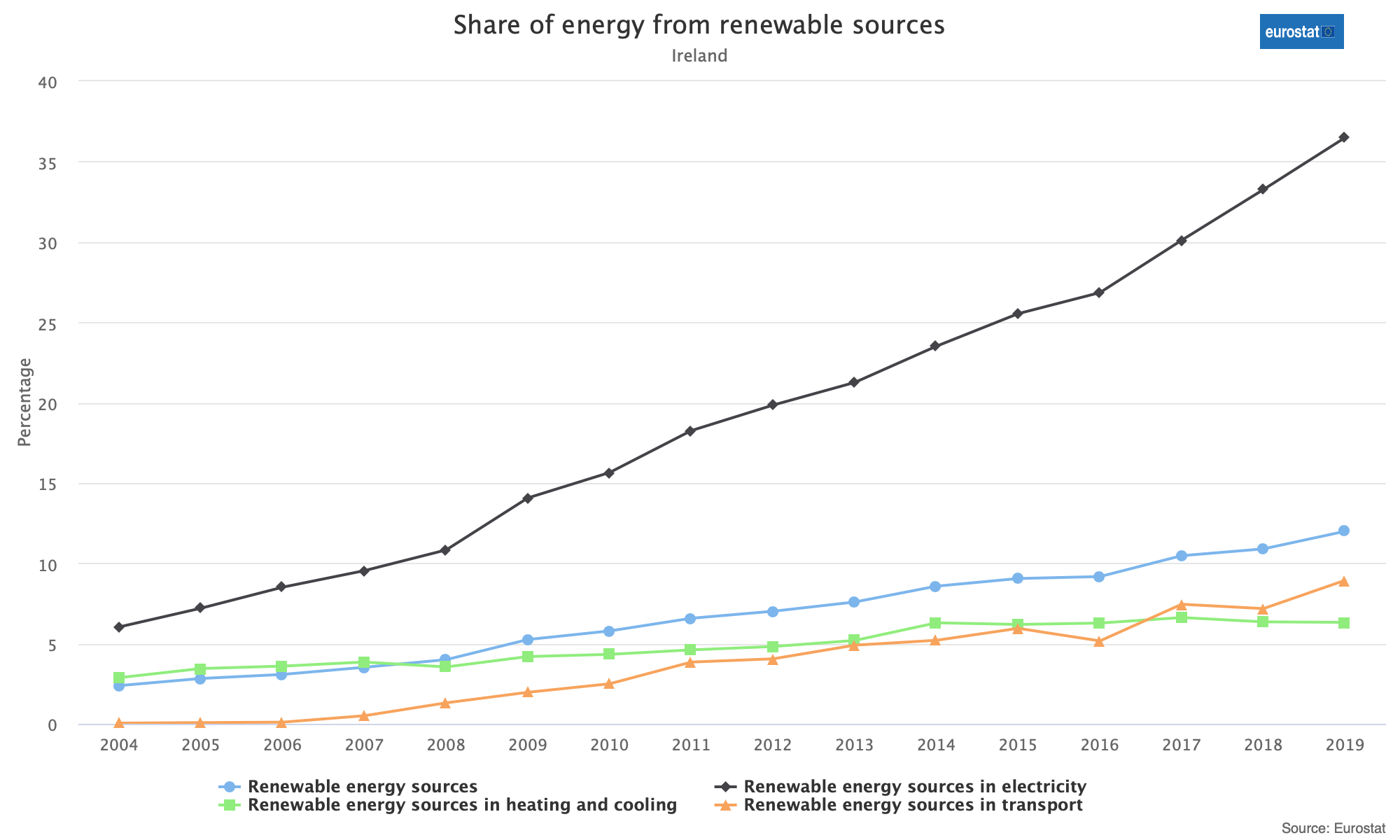
Eurostat is the statistical office of the European Union. It gathers together the statistics from each member state’s statistics office, like our own CSO and aggregates and analyses from there. They’ve been making great strides recently towards making the data as accessible as possible and providing a number of visualisation tools and mapping resources. One such recent effort is their Energy Dashboard. There’s a lot of data from members states (energy productivity, efficiency, GHG emissions etc) here. But the visualisation tool makes it easy to select and compare across countries and categories. If you wish, the raw data in csv or excel format is also available for download.

Some broad trends here are the growth in renewables sources of energy production and the gradual declines in household energy use from highs in 2005-2010. On this latter category, household energy use data goes to 2019. I wouldn’t be surprised at an increase for 2020 with the increased amount of time we’ve all been spending in our homes. Similarly, GHG emissions from energy emissions have fallen over the last thirty years here with what looks look like a plateauing of emissions from 2015 until the last year for which data is available in 2018.

Posted in Uncategorized | Tagged , , | Comments Off on Energy Data For Ireland

Q1 2021 Seed Investment Data

Each quarter, the Irish Venture Capital Association release an overview of the investments made in companies here. Many (about 40-60%) of deals are undisclosed. However, those that are can reveal useful trends in who is investing how much in what. This quarter, it’s MedTech and Saas plays by number and amount in the lead. Mainstay Medical closed an €89M round and there were two >€20M in Brightflag (Saas) and Tines (Cybersecurity).

Posted in Uncategorized | Comments Off on Q1 2021 Seed Investment Data

Moving (back) to WordPress

I’ve spent the last few years playing with various frameworks like React and Angular (even Java and NetBeans) and using a lot of Bootstrap to roll my own websites to do various things. I think it’s time – after a loooong break to maybe go old school and jot down the odd thought here. It’s nice to have someone else take care of all the inter web magic of hosting, backups and design for a change. I’ll likely still try things – as in beat some libraries together with poor pipework – but as side projects. This should be the main place I go to in future.

Posted in Uncategorized | Comments Off on Moving (back) to WordPress

HealthBox 2013

I was at the HealthBox Open Day in London last Thursday where 7 mHealth companies pitched for investment to an invited audience. The companies had participated in the HealthBox 3 month accelerator programme developing aspects of their business as diverse as building financial projections and designing user interfaces. Many had managed to close a first deal, like Health Clinic Plus, or engage in a first pilot, like Mira Rehab. The point of engagement with the audience of prospective partners and funders was through a ten minute pitch that had been honed over the previous months. Two contrasting things struck me. One was the uniformly high standard of clarity and succinctness of the communication. The second thing was the uniformity, itself. The pitches tended to be two handers with a use case involving a “meet Joe Bloggs and see his day with/without our technology/service”. It left me a little conflicted. On the one hand, speaking from personal experience, I’d give my eye teeth to hone a pitch to the quality level I saw in London. On the other, it’s hard to raise money at the best of times and standing out from the competition for scarce cash is vital.

Posted in Uncategorized | Comments Off on HealthBox 2013

Is the era of profound innovation over?

Some interesting articles in this week’s Economist on innovation at http://www.economist.com/news/briefing/21569381-idea-innovation-and-new-technology-have-stopped-driving-growth-getting-increasing and http://www.economist.com/news/leaders/21569393-fears-innovation-slowing-are-exaggerated-governments-need-help-it-along-great. In short, the view is that the era of transformational change (steam, jets, telephones, etc) is behind us. We’re doomed to incremental innovation that will result in perpetually slow economic and productivity growth.

I don’t agree. I think that many of this era’s breakthroughs like computing and robotics will take time to bed down as measured in 10s of years just like the major technologies of the past. If economic growth is slowling in the developing world, I think automation and the ability to replace people with machines is a  growing contributor – see “Race Against The Machine” by Byrnjolfsson and McAfee, for example. There’s also the ongoing impact of several years of recession.

The narrative that things like sanitation, especially the toilet (see current cover of the Economist) just arrived and improved human health over night is simplistic. The precursor, the privy, was around for a very long time. Like steam (the Greeks and Romans had simple, toy steam engines), it took a long period of tinkering before it became a useful and widely used appliance. The humble U-bend being the key breakthrough in the case of the toilet. As such, it’s too early to tell if this is a fallow period in innovation. Proxy measures like changes in economic growth or productivty rates likely have a complex mix of causes.

Posted in Uncategorized | Comments Off on Is the era of profound innovation over?

Connected Health Symposium Recap (Part III)

In addition to the innovators I spoke about in my last post, I also heard from panels of investors, advocates and horizon scanners about what it takes to develop Connected Health offerings. There are some interesting trends emerging from the investment/financial side side. For example, insurers are now beginning to provide venture investment in healthcare startups. Bill Geary, a partner at North Bridge Venture Partners, discussed his view that healthcare provision will become increasingly consumerised. Rather than having insurers and healthcare professionals take care of illness, individuals will move to decide on what they want and from which provider. One major driver is the rising deductible in healthcare insurance where the insured will have to pay the first, and ever rising, quantum of payment for healthcare. This will drive people to seek both value and quality. This trend may already be underway with some 9,000 health apps currently in Apple’s App Store, for example.

Taking the consumerisation of healthcare the furthest was Eileen Bartholomew, Senior Director of Life Science Prize Development at the X Prize Foundation. She outlined a new prize in development – The Tricorder X Prize – that will award €10M to a team that develops a mobile solution that can inexpensively diagnose patients by combining expert systems and medical point-of-care data. The aim is to “deskill” healthcare.

A final group, “The Futurists”, debated the trends in Connected Health during the final session of the meeting. Vaishali Kamat of Cambridge Consultants felt that the hot emerging technologies were likely to be microfluidics, low power, small sensors, user interfaces incorporating natural speech and communications. Peter Tippett of Verizon felt an emerging macro-theme was the putting of the patient into the centre of healthcare for the first time. However, he cautioned that the explosion of data resulting from Connected Health solutions required algorithms and data fusion methodologies to create knowledge and make it available in a usable format in a timely fashion at the point of decision making. A further caution came from the growing need for security in the storage, transmission and use of the data.

The closing talk was given by Joseph Kvedar, Director of Partners Centre for Connected Health, who spoke about what will be required to effectively change behaviour and improve outcomes for people to best benefit from the promise of Connected Health. This will require effective feedback loops of the sort recently written about in Wired Magazine. Firstly, provision of timely evidence of a behaviour, the relevance of it to your health, the consequences and finally an action to revert to more benign, adaptive behaviour. Several testimonies of people who’d benefited from Connected Health interventions were presented that illustrated vividly the power of this approach.

On the whole, the Connected Health Symposium was a thought-provoking blend of summing up where healthcare is today with a glimpse of what the future holds in terms of convergence between medicine, information technology and user psychology. Glad I went!

Posted in Uncategorized | Tagged , , | Comments Off on Connected Health Symposium Recap (Part III)

Connected Health Symposium Recap (Part II)

I had the good fortune to see short pitches from about 30 innovators with new products and services at the Connected Health Symposium. What follows is an attempt to synthesise the key trends in new Connected Health solutions.

In order to succeed, a new offering will need to have clearly articulated points of uniqueness  and innovation that create value. I saw many WiFi/Bluetooth enabled products, electronic patient records, cloud-based video and mobile apps. In the absence of clear differentiators, this space is in danger of being commoditised.

However, I did see some standout products that point to certain trends. Nuance is using its natural speech recognition prowess to develop a new take on eHR. It “listens” to the clinician and populates relevant fields. What is more, it is being positioned as an eHR that empowers the patient, too, through capturing what this key stakeholder has to say about their condition. The Healthrageous service also develops this theme of patient engagement through a holistic healthcare management service. Their app allows users to personalise their own healthcare management and set their own goals around things like diet, weight loss and exercise.

Several companies are trying to create a platform environment similar to Facebook or iOS, often cloud based, onto which third parties can develop and base services and apps. Examples include Grand Care Systems (had a great phrase about moving from the quantified self to the influenced self) and Independa. Another trend was the use of robotic systems to accompany patients, such as Vgo’s €6k telepresence robot and avatars. I was especially struck by Timothy Bickmore’s talk about an avatar that deals with patient hospital release. What was remarkable was that users overwhelmingly preferred dealing with the avatar over a healthcare professional. One likely reason is that they could spend a lot longer with the avatar and have more confidence they understood their meds and other needs fully. Aligned with this, there were whole sessions devoted to psychology and game mechanics in the design of apps and patient/consumer interfaces aimed at driving and sustaining positive health-related behavioural change.

On the whole, these innovators were sanguine about their prospects and very positive about the future of healthcare. They all had concerns about funding, finding appropriate talent for their companies (especially programmers), securing intellectual property and navigating the evolving regulatory environment. However, they all had exciting offerings and data about their utility. I look forward to seeing how they turn out….

Posted in Uncategorized | Tagged , , | Comments Off on Connected Health Symposium Recap (Part II)