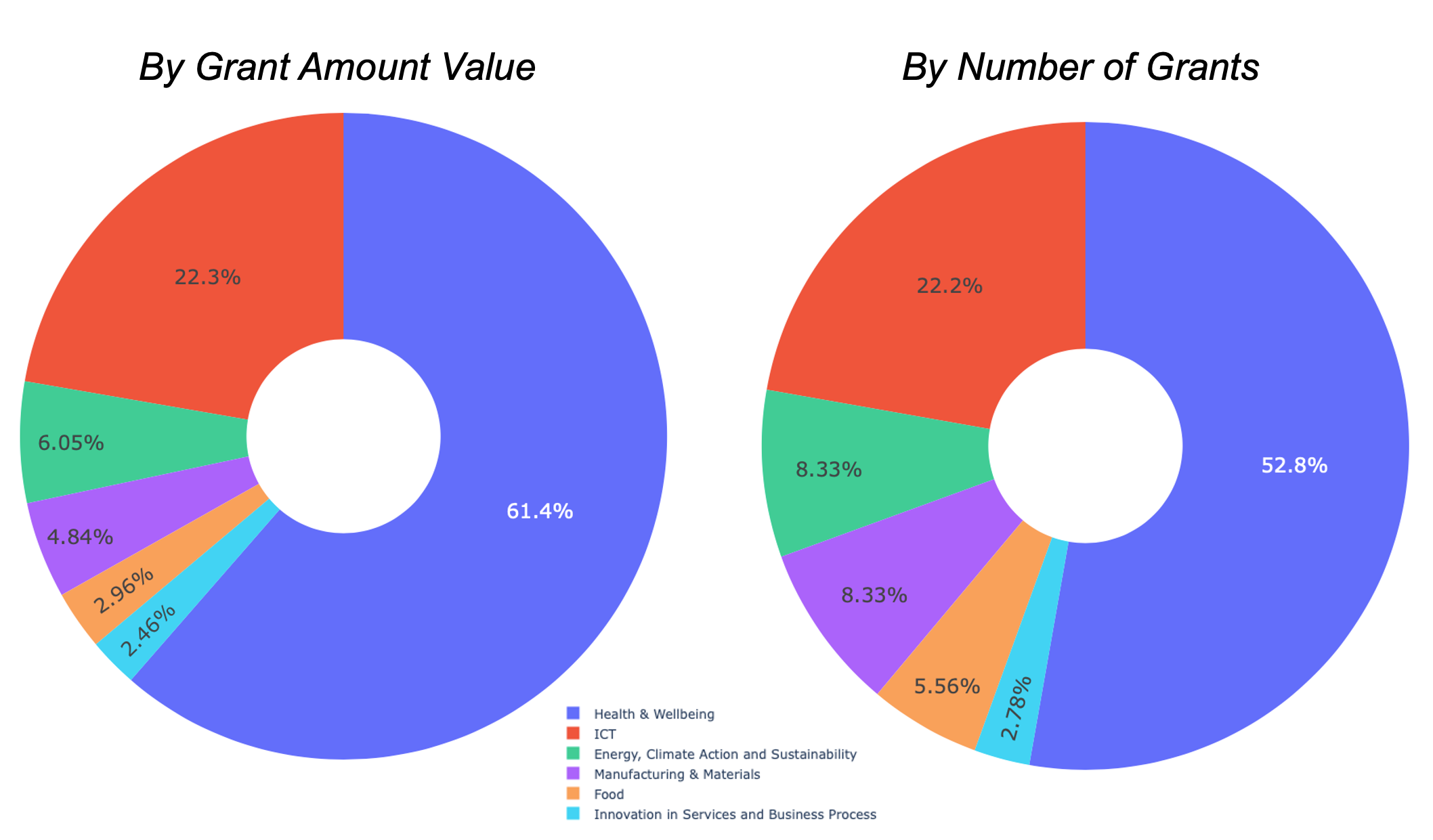
In 2018, the Irish government launched a €500M fund aimed at supporting Irish companies with groundbreaking technologies. The fund is run by the Department of Enterprise, Trade and Employment with the call being managed and assessed by Enterprise Ireland. There have been three calls to date funding 72 projects to a total of €240M (€78.5 in 2018, €65.5 in 2019 and a record €95.7M in the most recent call). The majority of funding, whether by amount of funding or number of projects funded, goes to Health and Wellbeing projects (blue) followed by ICT (red). There are occasional projects in other sectors such as Food and Manufacturing & Materials. Considering the government’s commitment to climate action, the low level of Energy, Climate Action and Sustainability projects is notable – with 1 project in the initial call, 2 in the second and 3 in the third.
Share of overall awards by county based on locations of DTIF lead applicants
DTIF awards range in value from €1M to almost €10M with a mix of small, medium and large companies collaborating with third level institutions. Looking at the locations of the lead applicants, there is a concentration of project leads in Dublin and Galway followed by Cork and the Limerick region with the associated presence of nearby cities and third level institutions. Dublin City University (DCU) has participated in 5 projects to date worth over €11M with DCU spinouts like Pilot Photonics and Remedy Biologics leading others.
With half the fund left to spend, it is likely there will be 2-3 more calls at current burn rates by the government under this fund with one expected to open later this year.
Science Foundation Ireland (SFI) has just released data on some 6000 research projects led by 118 organisations funded over the last 20 years. It’s a grand total of €3.5Bn awarded in that time. The data is at https://data.gov.ie and has been made available in csv, xl and pdf formats. It runs from 2002 to April this year. I’ve attempted an initial description of the data here.
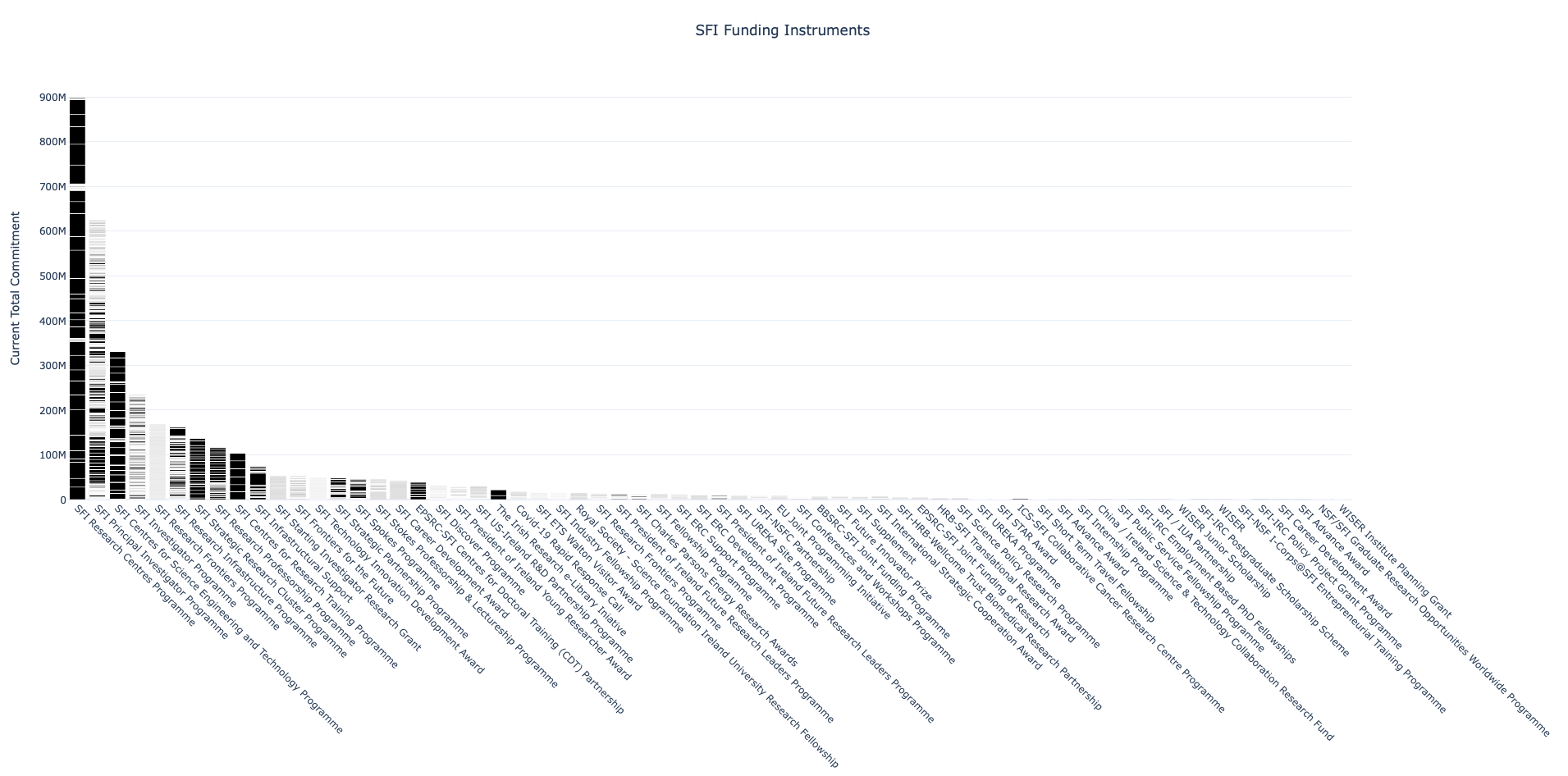
The first thing to note is that the funding is spread over 64 different schemes. In a nice demonstration of Pareto’s Law (aka the 80/20 rule) 20% or 13 schemes (first 13 from left of the above chart) account for just over 76% of projects.
Value of Projects Funded In Each SFI Scheme
Looking at the data by monies awarded on each scheme, we end up with a different ranking of different schemes but again a top 13 (or 20 % of all) schemes account for 84% of the spend.
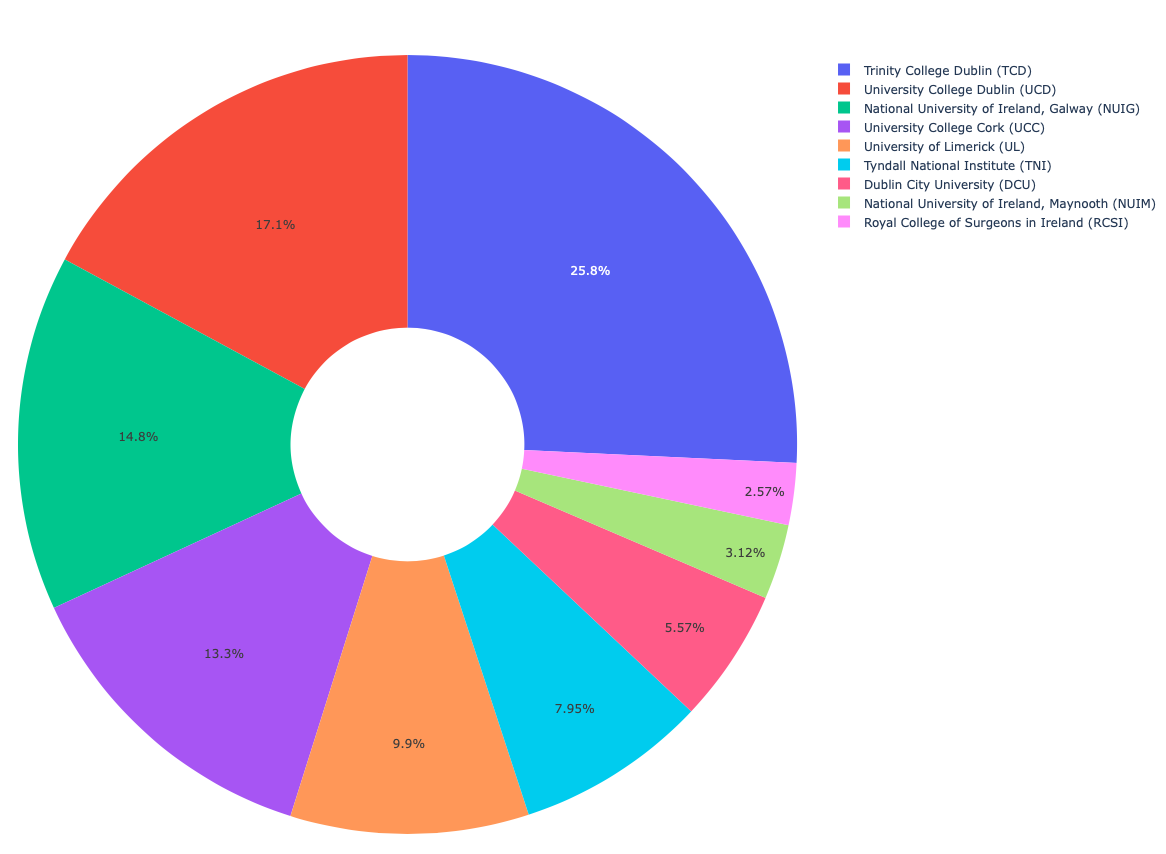
Proportion by University of €3.4Bn of SFI Spend on Projects Led by a University
Looking at the 118 organisations listed as leading an award from SFI, there is a great deal more concentration still. Here, some 9 institutions lead almost 5300 of the 6000 projects that are worth €3.4Bn – the majority of the funding. However, this is not to say that these are the institutions that consume the funding. Instead, they are the lead institution in what may be a consortium of research performing organisation and companies. For example, the single largest category of spend is to be found in the SFI Research Centre Programme (almost €900M to date). For instance, in the case of the INSIGHT Centre, helmed by DCU’s Prof. Noel O’Connor, the lead university is listed in the dataset as NUIG. However, the monies flow to the centre partners from the lead university to allow the research at each site take place. In the case of INSIGHT, this includes DCU, UCD, TCD and others. As such, this facet of the dataset is likely a reflection of the fact that universities can manage large, complex projects and lead research consortia composed of several parties that undertake the research collaboratively.
The CSO has just released provisional retail data for April. Sales volumes are up over 7% compared with March but off 2020 highs seen last year in July-October. However, much of this monthly increase is associated with Motor sales. If these are stripped out, there is a decline of around 4% in sales volume from March 2021. Even so, this figure is still up over 25% on April lows in 2020 during the earlier part of the Covid pandemic. Hopefully, overall, the recovery continues.
The European Innovation Council (EIC) is focussed on the issue of converting the research occurring in the EU into impact through startups. Over the last 25 years, the EU has become ever more ambitious with funding pan-European research programmes. However, the translation of this research into new companies delivering the fruits of this research and innovation were thinner on the ground than was expected. Part of the EU effort to redress this issue was the establishment of various company funding instruments including the EIC’s Accelerator fund.
Source: EIC
With the EIC having another call for Accelerator funding applications closing next month, I thought I’d have a look at the performance of Irish companies over the last 6 years.
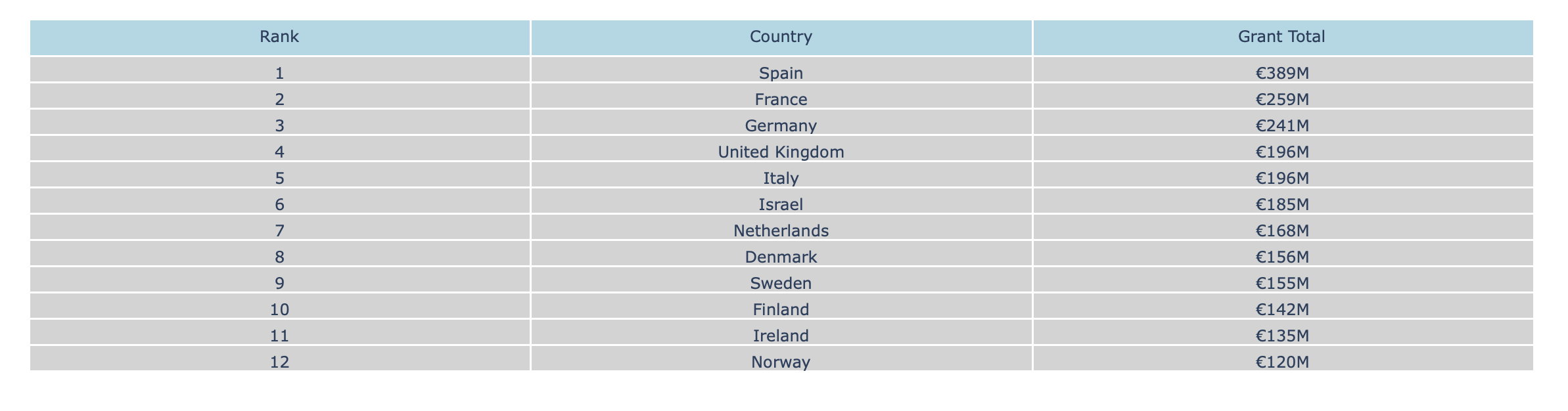
The Accelerator programme provides for both grant and equity investments in European companies. Shown here is the grant portion of the investments which can range from €50k to €2.5M per company. Startups such as Dublin City University spinouts Remedy Biologics and Novus Diagnostics have benefited recently from this instrument. Overall, Ireland ranks 11th for receipt of Accelerator grant funding, slightly below but not far off from innovation intensive economies of similar population size such as Finland and the Netherlands.
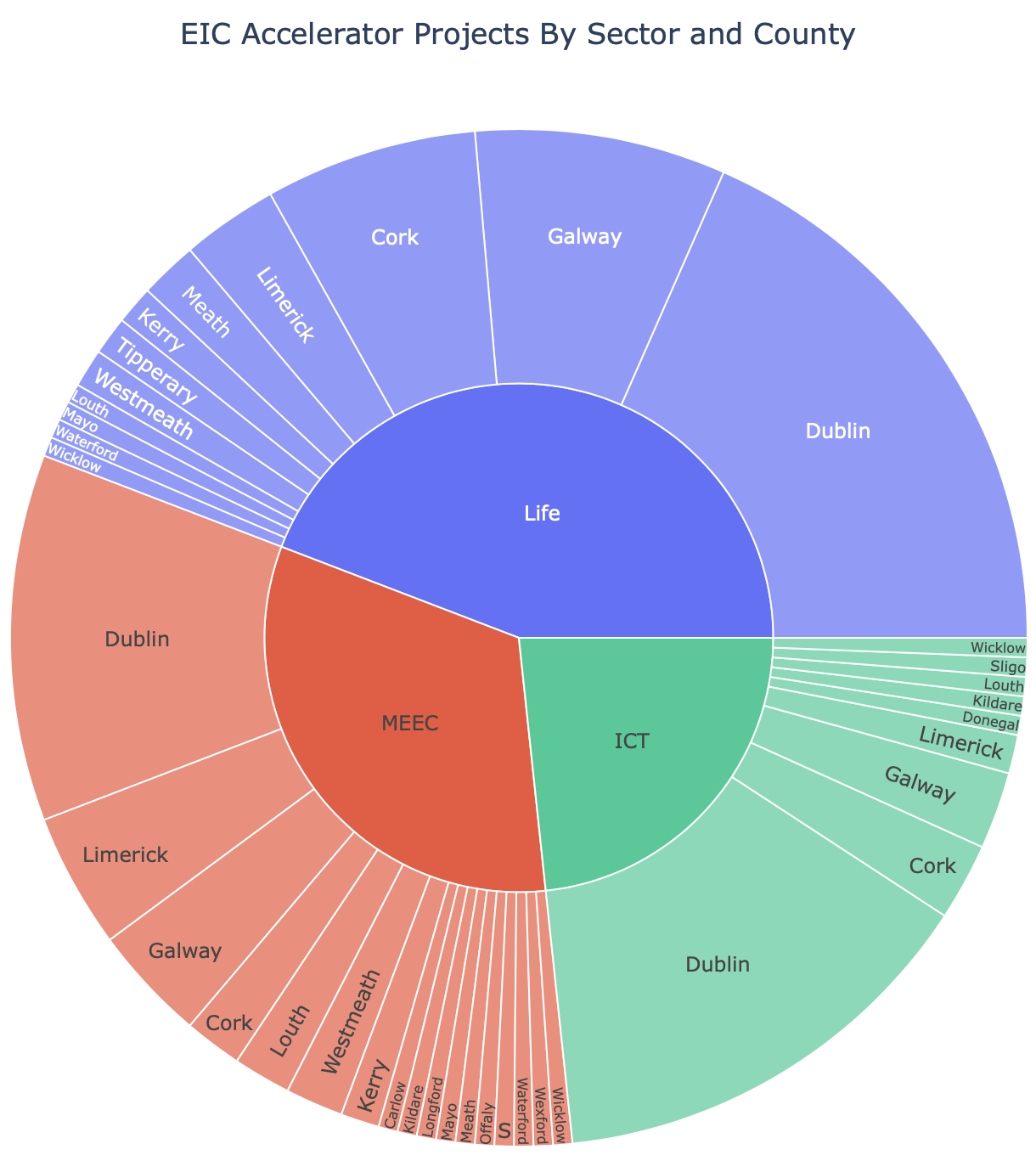
Breaking out the Irish data, some 164 projects have been funded amounting to almost €135M in recent years. The most projects were funded in Dublin (72) followed by Galway (23) and Cork (18). Here I divide the projects into the three broad categories of Lifesciences (Life), Information and Communication Technologies (ICT) and Manufacturing, Engineering, Energy and Construction (MEEC). Lifesciences is the largest category overall (72 projects) followed by MEEC and ICT. Whilst Dublin is still the largest beneficiary in each category, we can see Galway with its vibrant medtech sector as a close second in the Lifesciences. In ICT, it is Cork that is the second largest beneficiary. In MEEC, Limerick followed by Galway are the next largest counties. In the cases of counties with the largest numbers of these awards, it is likely that the presence of cities and third level institutions are closely associated with the fertile and supportive environment that is necessary for larger groupings of innovative new companies to emerge with the right type of opportunity to benefit such large scale investment.
Wordcloud of all EIC Accelerator project titles 2014-2020
With the next call for EIC Accelerator funding closing in mid-June, it is worth investigating for early stage companies with truly innovative and disruptive technology offerings. The monies (€2.5M in grant and up to €15M in equity) can be truly transformative for successful applicants. Each of the EU member states has a National Contact Point (NCP) for this and other European Commission funding initiatives. If you’re thinking of applying, they are a great source of information, guidance on the documentation needed and assistance in finding partners. In Ireland, see https://horizoneurope.ie for your NCP and more information.
Food and agriculture in Ireland continue to be important sectors in terms of jobs and exports. Many of the major home grown multinationals here are in food like Glanbia and Kerry Group. Primary production in agriculture involves almost 150,000 farmers. Ireland is one of the largest dairy export nations in the world, exporting 85% of all dairy output and accounting for more than €3 billion in exports per annum. The meat sector accounts for exports of nearly €4Bn with a similar proportion of product being exported as in the dairy sector. However, food and agriculture are coming under increasing pressure. For example, the UK accounts for 40% of beef exports. Due to Brexit, the latest CSO data shows Food and Live Animal exports to the UK down 25.6% in Q12021. When this is added to current and potential trade deals with other major dairy and beef exporters such as South America, New Zealand and Australia in the near term, there will be significant and continuous pressure put on the Irish dairy and beef sectors for some time. Furthermore, the environmental impact of farming and food production is coming under greater scrutiny from consumers with a growing move to alternatives perceived as being more environmentally friendly and with less GHG emissions.
As always, the above problems are also opportunities for AgTech and FoodTech innovation and for the startups that can provide it. Over the last few years, several AgTech incubator and accelerator facilities have emerged to serve such startups. Among these are ACE in Kerry, PACE in Kilkenny and AgTechUCD. These are also associated with universities of significant expertise and early stage innovations and IP in the space that are available for licence and commercialisation. Associated universities are Munster Technological University, Waterford Institute of Technology and University College Dublin, respectively. I’d also point to Ireland’s national Food, Agriculture and AgTech research and agronomy centre, Teagasc.
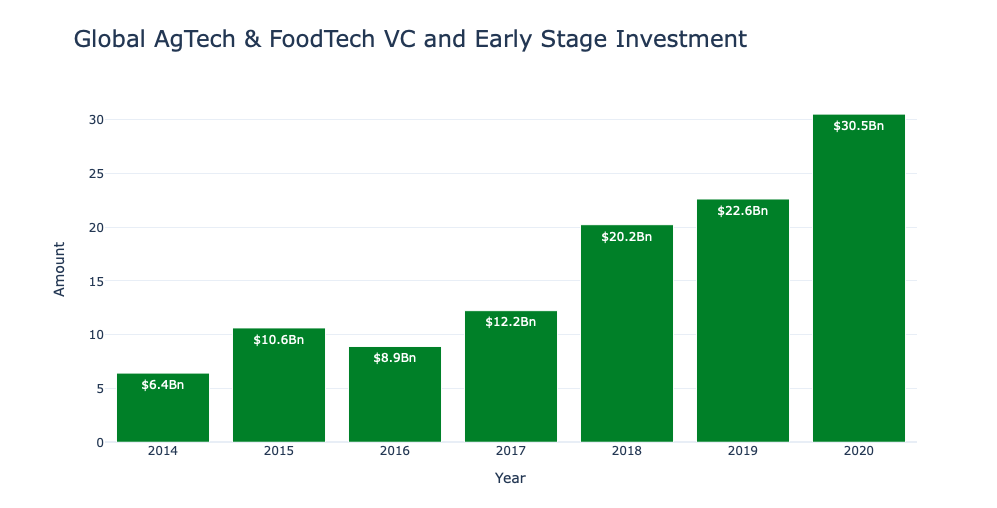
A vibrant funding environment is also needed to support emerging AgTech and FoodTech startups. Recent data shows the sector growing rapidly globally. Stock market listings for FoodTech and AgTech companies grew 8 fold in 2020, for example. Global VC investments amounted to over €30Bn in the space and have grown consistently for several years now. I’ve had a look at the seed and venture funding going into FoodTech and AgTech companies in Ireland. Looking at all Irish VC investment in 2020, which amounted to €1Bn invested in 264 companies overall, there is clear room to grow this sector in Ireland from a current 5% level of investment in AgTech and FoodTech.
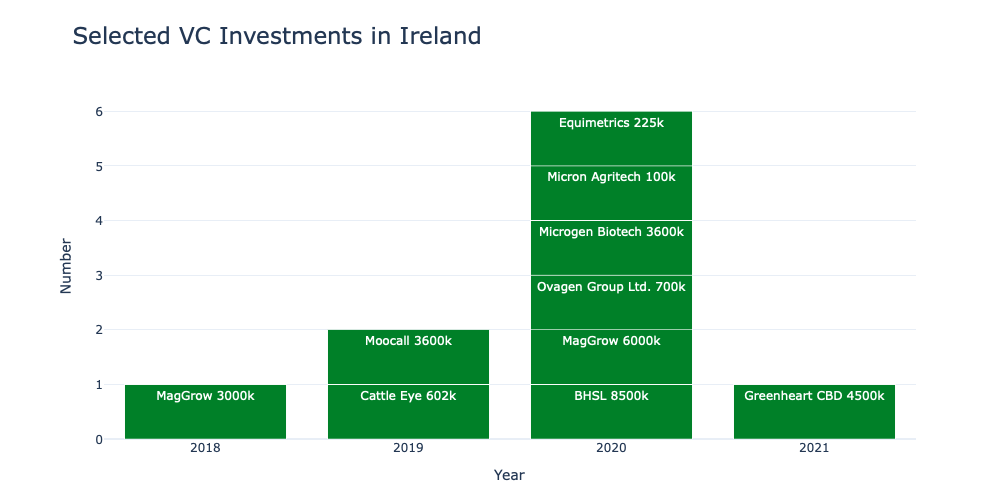
There are local VC funds such as Yield Lab and Finistere that specialise in funding startups in the AgTech and FoodTech spaces. They often co-fund in a syndicate of other private and VC investors. Looking at recent investment data in Ireland from TechIreland, there were investments in 14 AgTech companies in 2020, unchanged from the previous year. However, in contrast to 2019’s €30M invested in the sector, some €38M was invested in 2020. Where the data has been made available, the startups are active in AgriBiotech (eg. Micron Biotech) and automated animal monitoring (eg. Moocall, Cattle Eye, etc) and food products (Greenhart CBD). Considering that the specialist funds are early in their investment cycle and the growing interest being shown by privates and other funders in the space, it looks like it has room to grow.
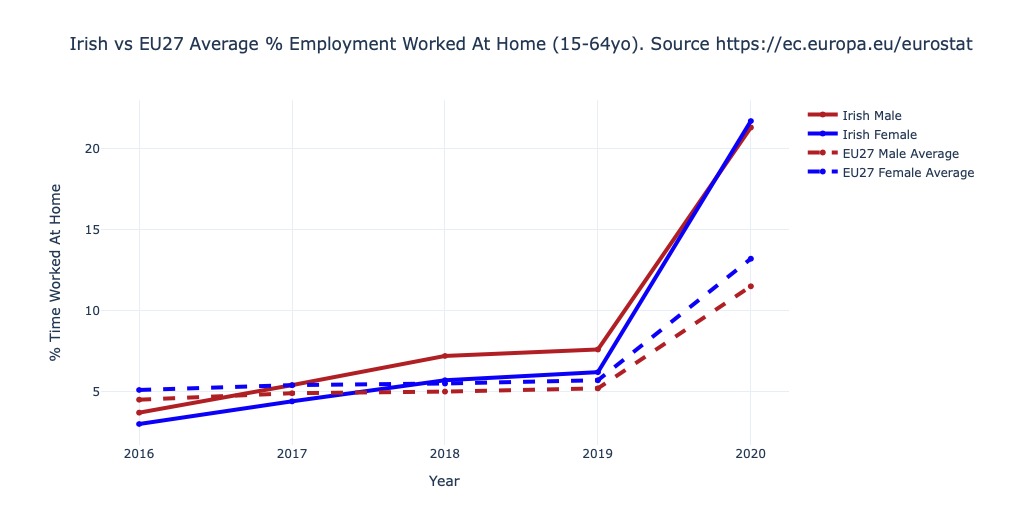
One thing I’m interested in is the myriad impacts of Covid 19 on our lives. For many of us lucky enough to have jobs that can be done in part or whole from the home, this has resulted in a big increase in the amount spent there. Today, Eurostat have released a study of member state employment data quantifying the overall levels of working from home across the EU. From an EU wide steady state level of 5% on average of total employment time worked from home for 15-64 year olds, the EU average has increased to 12.3% in 2020 as a consequence of Covid 19. The data for Ireland is well in excess of this. With an average of 21.5% of employment time being spent working from home, Ireland has the third highest figure in the EU exceeded only by Luxembourg (23.1%) and Finland (25.1%).
When looking at the figures by gender, on average, women worked a slightly higher percentage of time at home (13.2%) across the EU compared with men (11.5%). However, in Ireland, the figures for men and women are almost identical at 21.3% and 21.7%, respectively.
It will be interesting to see how durable this increase in working from home is now that vaccination programmes are in full swing across the EU and employers move to bring their workforce back to the workplace.
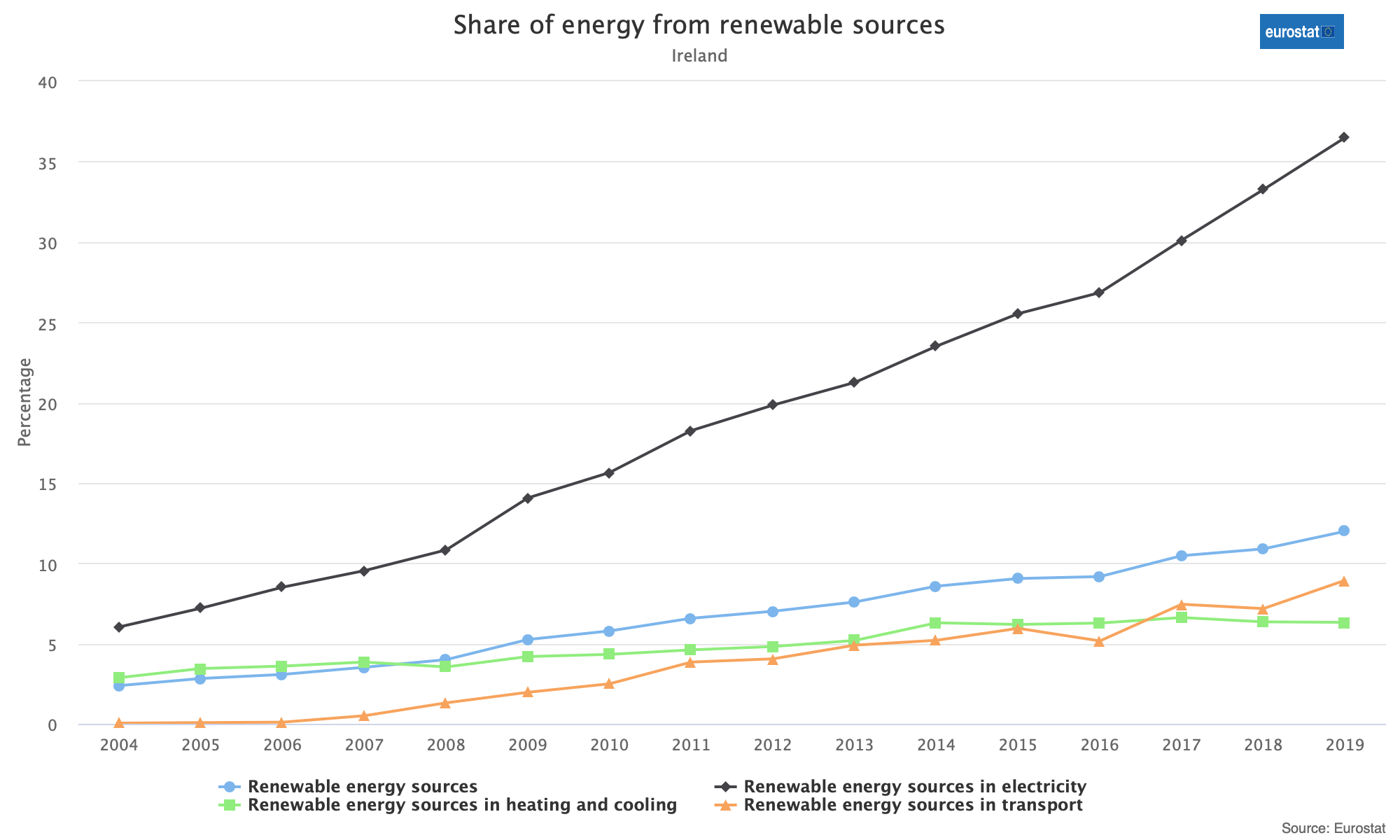
Eurostat is the statistical office of the European Union. It gathers together the statistics from each member state’s statistics office, like our own CSO and aggregates and analyses from there. They’ve been making great strides recently towards making the data as accessible as possible and providing a number of visualisation tools and mapping resources. One such recent effort is their Energy Dashboard. There’s a lot of data from members states (energy productivity, efficiency, GHG emissions etc) here. But the visualisation tool makes it easy to select and compare across countries and categories. If you wish, the raw data in csv or excel format is also available for download.
Some broad trends here are the growth in renewables sources of energy production and the gradual declines in household energy use from highs in 2005-2010. On this latter category, household energy use data goes to 2019. I wouldn’t be surprised at an increase for 2020 with the increased amount of time we’ve all been spending in our homes. Similarly, GHG emissions from energy emissions have fallen over the last thirty years here with what looks look like a plateauing of emissions from 2015 until the last year for which data is available in 2018.






 Sean Mulvany